Sep 7, 2009

MEAL THREE: TRADITION

(menu + recipes at bottom)

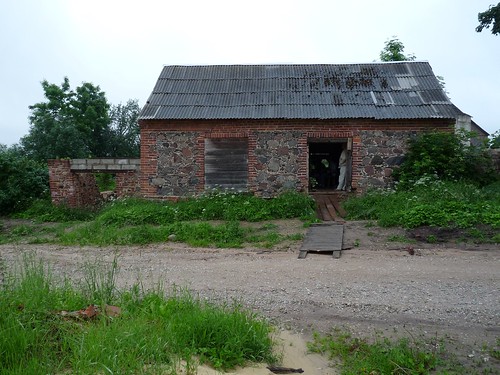
Grigori's Bar(n)
The Barn

LISTEN TO MUSIC AS YOU READ...


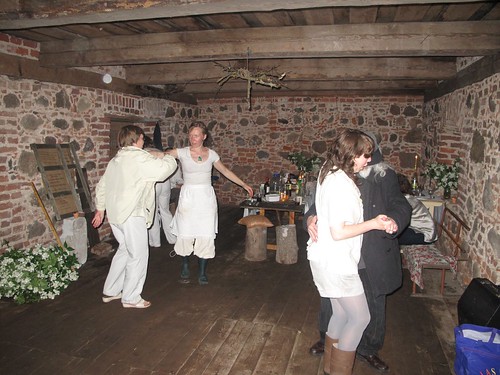
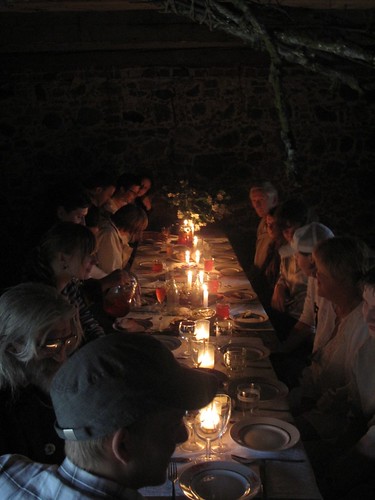
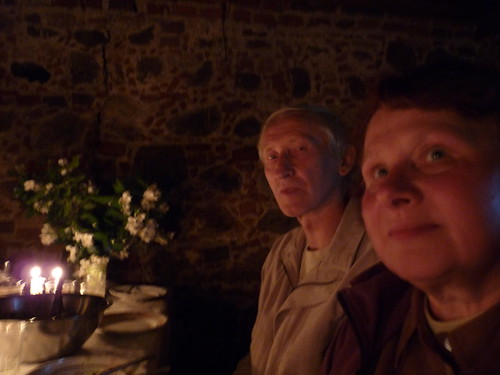
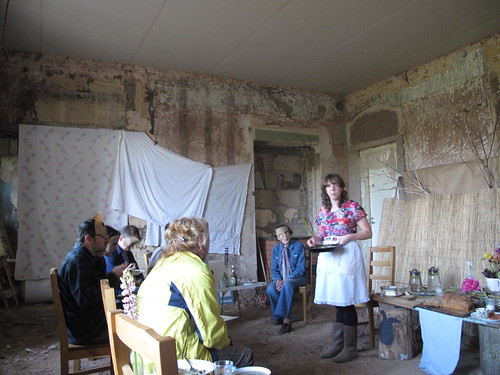
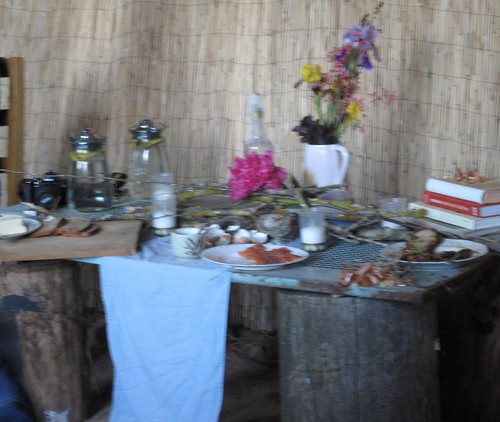
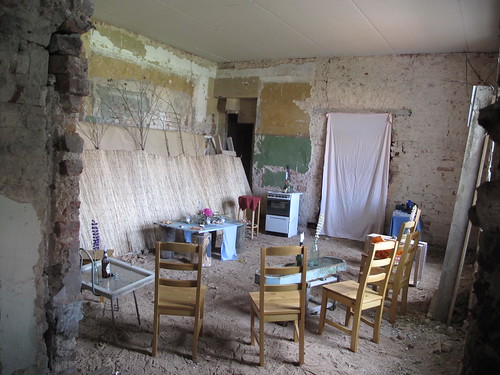
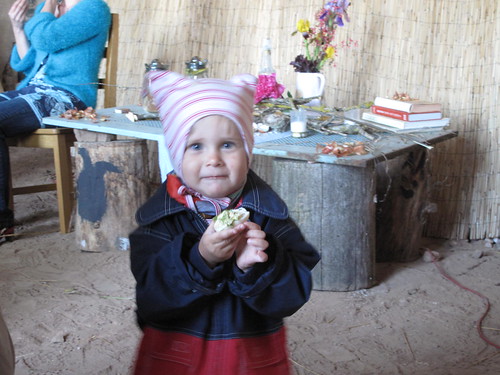
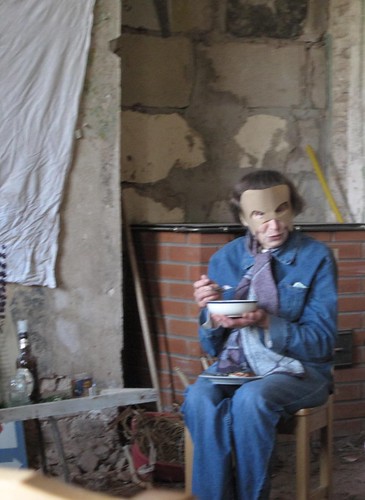
Meal Three was held in an old barn near MoKs and was structured as a formal dinner that referenced traditional “special occasion” customs. Everyone was asked to dress in white. Tables and chairs were fashioned out of tree stumps and fallen doors, and candles and handmade stringed instruments were installed directly into the surface of the table. Evelyn decorated with beautiful white flowers and fabric. A local band played Estonian and Russian music on accordians, karmoshkas and harmonicas. We dined family style from large platters and bowls in three courses. We sang, danced and drank too much.
chain gang

THE MUSIC >>>>>>>>>>>>>>>
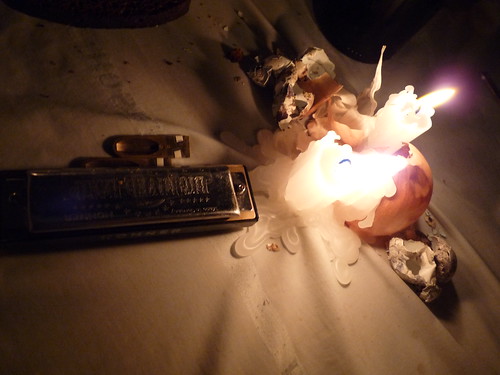
Harmonicas and reeds were left on the table without any instructions, to occasional adhoc use. The band, 3 accordion/karmoshka players from the village community (Siim, Mörgus, and their mother Ene), as well as Henrik on his harmonica, played traditional songs and led a series of sound actions to organize the evening‘s activities:

1. Silence (environmental listening)
2. Stork Exercise
3. Background and Participatory music
4. Table Chain-Reaction
5. Dance Music

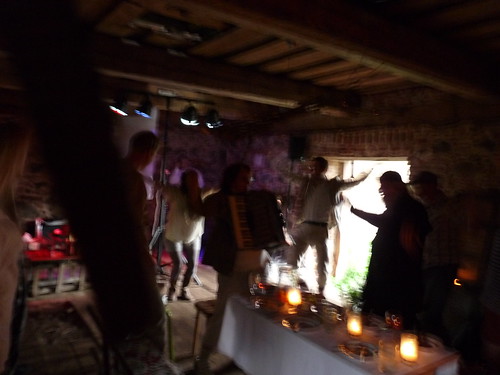
We started with a round of silence to take in the rain that had completely altered our original location setup and complicated our preparations. Inspired by the magical local winged creatures, after the first course everyone was asked to stand up and was guided through a 'stork exercise' - lifting the arms and raising the pitch and volume of their voices accordingly and shaking their bottoms as if settling into a nest. Stimulating the range of the body, using the voice expressively, lightly undoing some inhibitions, breaking ice.
Stork Wing Song Dance
Whoops, and the Flapping of Wings
Helvi stork spirit
Helvi and Stork Spirit

After the second course Siim led a series of table-chain performances, where everyone at the table was asked to make a sound – either with an instrument that had been left on or installed in the table, or with any other sound-making object – in a chain or circle, thereby producing a small impromptu piece.
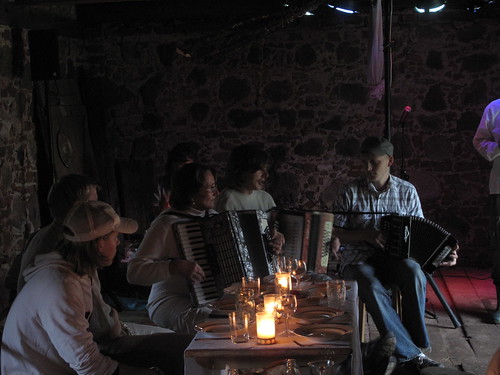
Throughout the meal the musicians played traditional Estonian and Russian folk songs, which all the local participants seemed to know and sing along with, whether with genuine appreciation or a cheerful and nostalgic rolling of eyes. The music entertained everyone so beautifully that the musicians continued playing songs for several hours.
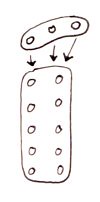
IMG_4426                         IMG_4424                             IMG_4425
1. Musician scenario             2. Stork Exercise                   3. Chain-Reaction Exercise
+ singing
The musicians, Mörgus, Ene, Siim.
dancin
Dancin'
THE TABLE >>>>>>>>>>>>>>>
table
THE FOOD >>>>>>>>>>>>>>>
The meal was structured in three-courses. What we served had been largely determined by what produce was in season, like radishes, mushrooms and potatoes, and what we foraged in the village, like rhubarb, nettles and dandelion greens. We referenced traditional foods, like herring and organ meats, and presented them in a new light as "special occasion" foods. Certain ingredients, like quail eggs, we were surprised and delighted to see in so many Estonian recipes and in abundance at the market, and had to find a way to use them. The centerpiece of the meal was a wild boar stew made from meat supplied by a local hunter (see previous post) and garnished with locally foraged chanterelles. All the vegetables and herbs were local, either foraged, from Evelyn’s garden or purchased at the Tartu farmer‘s market. The menu is listed below. Any item with an asterik has the recipe listed at the very end of the post, all others should be self-explanatory.
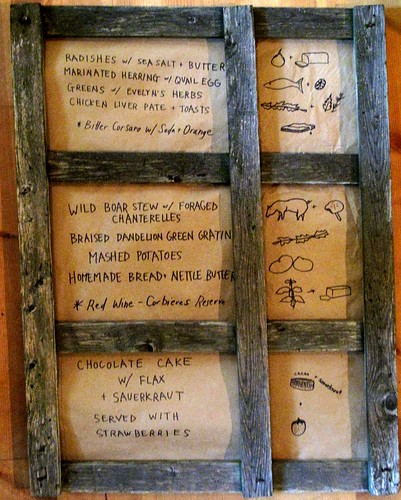

meal 3 menu
The Menu

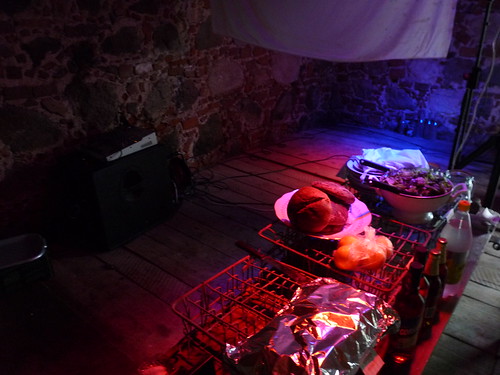
prep station
The Prep Station (Originally conceived as a bar.)

COURSE 1
RADISHES W/ SEA SALT + BUTTER
*MARINATED HERRING w/ QUAIL EGG
GREENS w/ EVELYN’S HERBS
*CHICKEN LIVER PATE + TOASTS
Bitter Corsaro w/ Soda + Orange

COURSE 2
*WILD BOAR STEW WITH CHANTERELLES
*BRAISED DANDELION GREEN GRATIN
MASHED POTATOES
HOMEMADE BREAD + *NETTLE BUTTER
NV Corbieres Reserve

DESSERT
*CHOCOLATE SAUERKRAUT-FLAX CAKE WITH EVELYN’S STRAWBERRIES
*Rhubarb or Caraway Infused Vodkas


THE PEOPLE >>>>>>>>>>>>>>>>>>>
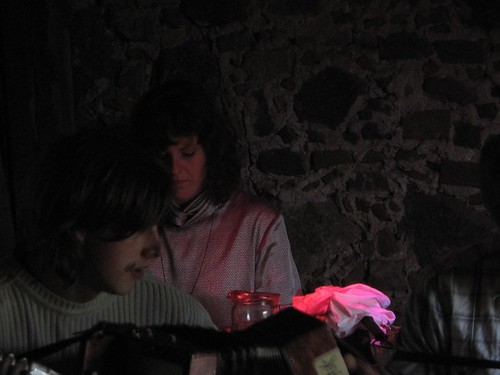
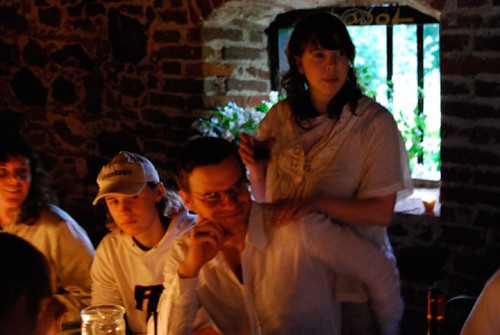
karmoshka! sandy!

emmatt meal 3

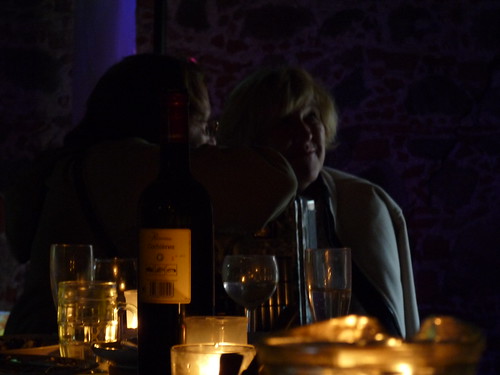
Ülle + Ena in barn glow

Jään + Helvi

THE AFTERMATH >>>>>>>>>>>>>>>>>>>

The day after our event folks in the community began re-landscaping the ground directly around the barn. Not sure what is becoming of it. Prior to our project the barn had been abandoned and was one of the main hangouts for local motor-biking teenagers.
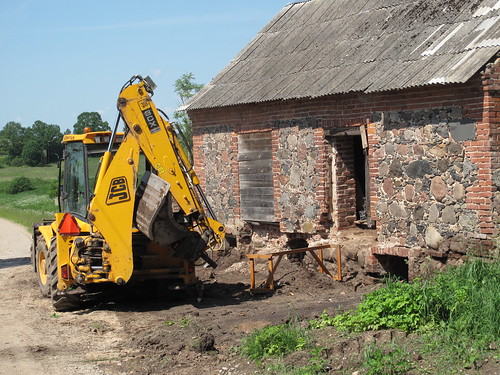
Days later, they reconstruct the Bar(n)

Since we‘ve left Mooste, Moks has procured a nice big refrigerator and have begun a garden project to help feed their residents.

RECIPES >>>>>>>>>>>>>>>>>>>>>>>>

MARINATED HERRING w/ QUAIL EGG
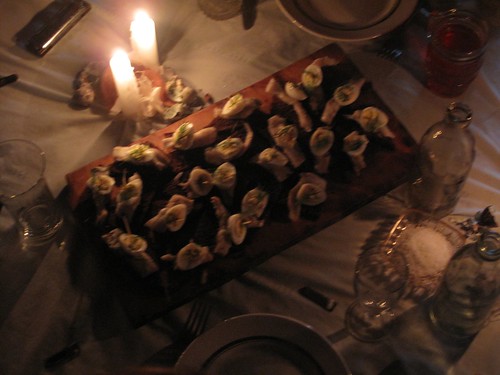
pickled herring+rye bread+quail egg+dill
Pickled herring on rye bread with quail egg and dill.

Clean herring fillets and cut into strips. Note if they have been preserved in salt or not – if so you will want to lower or eliminate altogether the salt you use to cure the herring. Bring to a boil enough white vinegar (or part vinegar, part water) to cover the herring in a jar. Simmer the liquid and add black peppercorns, a few tablespoons of sugar, caraway, juniper berries, and slices of garlic. Take off the heat after about a minute. Put the fillets in a jar with lots of dill, and cover with the liquid. Marinate in the fridge for at least a day.

To make the crostini, cut small triangles of black bread and spread with butter. Put a piece of marinated herring, half a hard boiled quail egg and a sprig of dill to garnish, and stick the whole thing together with a toothpick.

CHICKEN LIVER PATE + TOASTS
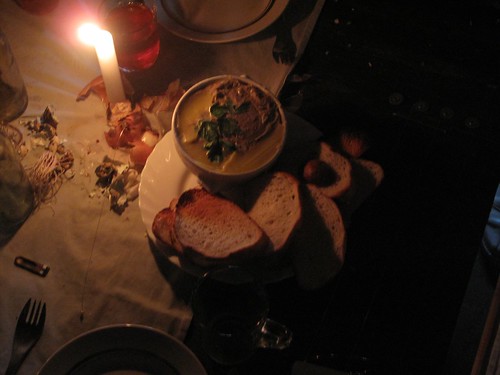
em's chicken liver paté+white bread
chicken liver paté + white bread

Clean and cut the sinews from chicken livers. Sautee garlic and onions with butter, add the chicken livers and brown on both sides. Season with salt and black pepper, then cover half way with good brandy. While the liquid reduces, mince parsley and sprinkle over the pan. Use an immersion blender to blend everything smooth, and add more parsley, seasoning and brandy to taste. Serve chilled with toast – and if you are fancy, put clarified butter over the top of the pate in its serving bowl.

WILD BOAR STEW WITH FORAGED CHANTERELLES

1. Cube the meat. Combine in large pot with carrots, yellow onions, parsley, garlic, thyme, bay leaves, peppercorns and salt. Cover with red wine and let marinate for 24 hours to tenderize. Remove meat from pot and reserve all the liquid.

2. Chop bacon and crisp. Use the bacon grease to brown the boar meat (it may take several batches depending on the amount of meat you are using). Cover the meat with a couple tablespoons of flour and return the bacon to the pot.

3. Add marinade back to the pot, simmer then reduce heat to medium-low. Cover and cook until tender.

4. While the meat is cooking, bring a pot of salted water to a bowl. Add peeled, chopped small onions and sugar. Simmer until onions are tender, about thirty minutes. Drain.

5. Chop chanterelles and sautee in butter.

6. When meat is cooked, drain from its liquid. Reheat the liquid to medium high and whisk in cognac and butter. Return venison to sauce, add onions and mushrooms. Mix, and serve with parsley on top.

BRAISED DANDELION GREEN GRATIN

Pick dandelion greens. Wash and boil in salted water with a little bit of vinegar. Drain. Make a béchamel sauce and covers several layers of cooked greens with béchamel in an ovenproof dish. Sprinkle breadcrumbs on top and pour heavy whipping cream over the dish. Bake.

NETTLE BUTTER

Pick and clean nettles. Steam to cook and pulverize with an immersion blender. Melt butter over low heat in a saucepan and mix the nettles in. Pour into a jar. While the mixture cools, mix to keep the nettles evenly dispersed. Sprinkle sea salt on top.

CHOCOLATE SAUERKRAUT-FLAX CAKE WITH EVELYN’S STRAWBERRIES
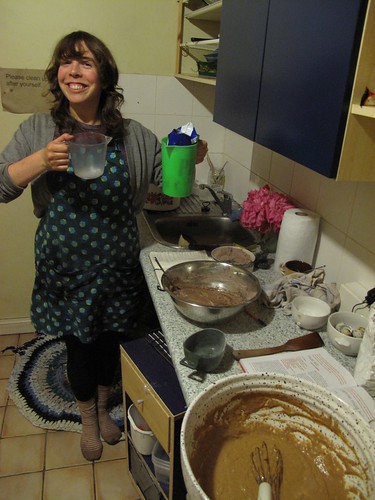
emma making sauerkraut chocolate cake + matt's must leib dough in foreground
Emma Baking Sauerkraut Chocolate Cake

I found the base for this recipe on Nami-Nami, which credited David Leibowitz for the invention. I was seduced by the recipe obviously because of the sauerkraut, which I had in abundance as leftovers from Meal 2. I made two key changes. First of all, I had wanted a dessert with flax as an ingredient, because a key industry in Mooste is the production of flax and linen. Unfortunately, I found very little on the internet to tempt me in this department, as most recipes simply use flax as an egg replacer. I too used flax in this way, but I used original amount of egg whites to keep the cake light plus a little extra flax to get a nuttier flavor. I also abandoned the more complicated ganache called for in the other recipes and made mine from old fashioned butter with chocolate melted in. This is a fairly easy cake to make, in fact the most challenging part of this recipe was finding a cake pan, which I ended up finding in a thrift store in Tartu. The sauerkraut lends moistness the way carrot does in carrot cake – except you don’t even taste it OR see it. And let’s just say: it was delicious. The recipe to follow is in metrics, sorry Americans!

1. Preheat over to 160 C . Rinse 100 g. sauerkraut, drain, chop finely.

2. Measure 280 g. flour, 50 g. unsweetened cocoa, 1 tsp. baking powder, 1 tsp. baking soda, and ½ tsp. salt into a bowl.

3. Separately, beat 150 g. butter with 300 g. sugar until light and creamy. Add 1 egg and beat into the mixture. Add 1 more egg and beat into the mixture. Add 1 more egg white and beat in. Mix 2 tbsp. flax seed with 6 tbsp of water separately, then mix into bowl. Beat smooth.

4. Into another bowl, add 1/3 dry stuff, 125 ml milk, another 1/3 of the dry stuff, another 125 ml of milk, the rest of the dry stuff, the sauerkraut, and 1 tbsp. of brandy (the original called for vanilla – you choose). Mix smooth, and pour into a greased baking pan. Bake for 45 min or until a toothpick comes out clean.

5. For the ganache, use the double boiler method to melt copious amounts of butter and chocolate together. Mix smooth, and use a rubber spatula to cover your cake when it is cool.

RHUBARB AND CARAWAY INFUSED VODKA
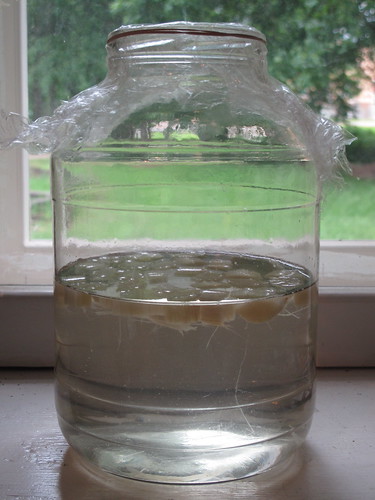
rhubarb vodka

Infusing is as easy as cutting up some rhubarb and putting it into a thing of vodka, or putting some caraway seeds into some vodka. And it’s so exciting!


Aug 18, 2009

AND WHAT A BOAR HE WAS!


It was a dark and stormy night when the Hunter pulled up to the Mooste manor house. He approached our door in his black rubber boots, a plastic shopping bag in his hand, a suspicious looking leg hinting from the top, its hoof gracefully articulated en pointe. What ended up costing only about $15 for at least ten pounds of rich, succulent wild boar surprised us that evening after an arduous request for fresh game. Our Hunter had been unlucky so far that month, and had kept us in suspense for some weeks about what he could bring us. After seeing my fair share of deer and rabbits I had gingerly asked Evelyn if we should try a different hunter, but was informed that our man was the head of all county hunters and it would be an insufferable slight to ask elsewhere. He ended up bringing us something from his pantry to compensate for his failure in the wood. No matter, it was delicious! However, we only had a mini-fridge... Luckily the walls in a stone house keep a dark closet cool. Necessity in indeed the mother of invention!

Jul 27, 2009

MEAL THREE (a taste)

Jun 30, 2009

MEAL TWO: AN EXPERIMENT

Participants: Ülle, Helen, Hana, Pärja, Evelyn, John, Tero, Karolina

PART ONE: HAY WOMB
Duration: Approximately 45 minutes

red+purple in the hay womb

Upon arriving, participants are asked to close their eyes and walk one-by-one through a tunnel. They open their eyes to find themselves in a room full of hay, lit by red and purple lights with red and blue fabric covering the windows. There are blankets and pillows scattered to get cozy in the lay. Music* begins to play.

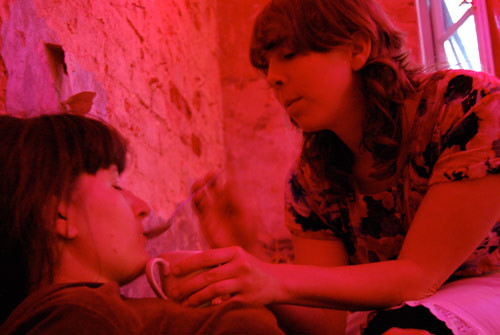
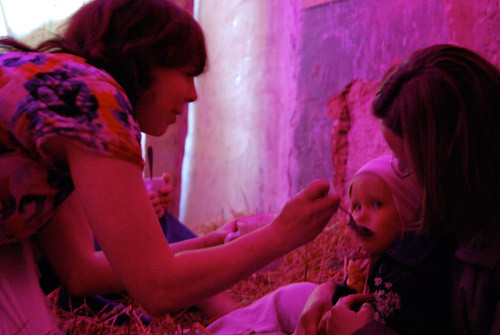
Emma walks into the room wearing a white apron and holding a large mixing bowl. She walks around misting everyone with homemade lavender spray, then crouches next to a participant in the hay with a cup that she has filled with mixture from the bowl and a spoon. She asks them, "Kama?" When they say 'yes', she spoon feeds them from the cup - a traditional kama mixture topped with sea buckthorn syrup - until they indicate they are finished or until they eat it all. She repeats the process with every participant, then exits. Participants are left in the room for an additional ten minutes before Matt enters to guide them out.

feeding sveta kama

feeding hana kama

*The music was composed of previously recorded material, Mooste field recordings, and re-compositions of the music used in Meal One. Little rhythm was employed in the music, but slow frequencies (à la brain waves) were emphasized to induce a relaxed state. Higher frequencies were filtered out to simulate the auditory experience of the infant within the womb.

KAMA WITH SEA BUCKTHORN SYRUP

Mix 500 mL kefir with a heaping scoop of kama. Add honey until it tastes delicious. To make the syrup, cover sea buckthorn berries with water, heat and simmer until they have rid themselves of their seeds and reduced to your desired consistency. Strain. To serve, drizzle the syrup over a bowl of the kama mixture.

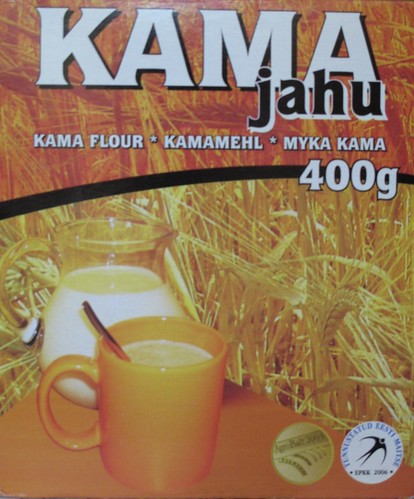
Estonia's only marketed national food product

Kama is one of the only foods advertised as being a 'true' Estonian product. Many Estonians will tell you it is their national food. It is a toasted grain flour or meal of peas, rye, oats and barley. Kefir, or fermented milk, is a staple of the Estonian diet and is as ubiquitous in the fridge as milk.

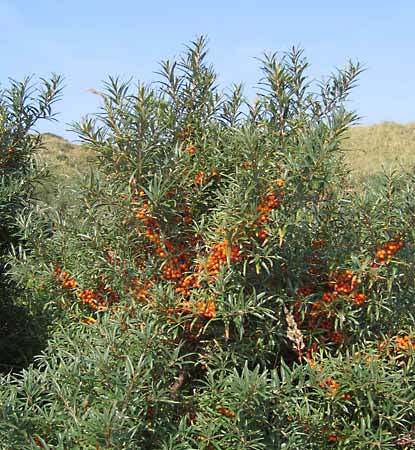
sea buckthorn
Sea buckthorn is a small, tart orange berry that grows on a bush in late summer in the Baltic region.

:::::::::::::::::::::::::::::::::::::::::::::::::::::::::
:::::::::::::::::::::::::::::::::::::::::::::::::::::::::


PART TWO: DINING ROOM

Meal 2: Emma servin it up

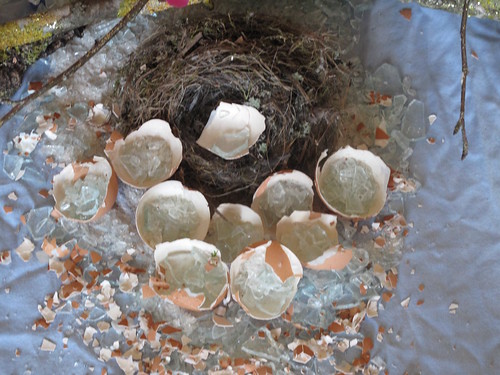
Matt enters the Hay Womb and leads each participant, one-by-one, to a seat in the dining room. The space has a dirt floor with windows opened to outdoor daylight (darkening into evening as the meal progresses). A low central table is against one wall, strewn with bird's nests, homemade glass glitter, apple wood branches, egg shells, onions skins, peonies, and books used by the artists during food preparation.

the gathering of courses

offering table

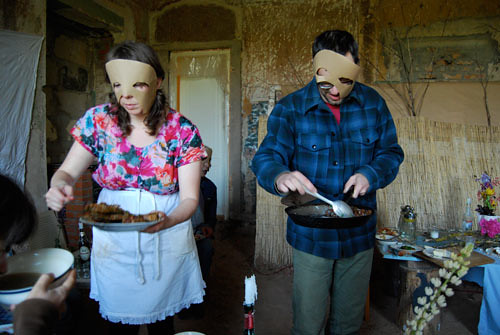
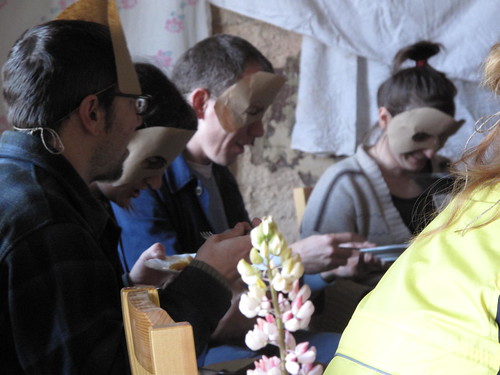
Chairs and small tables made from materials found in the village or MoKS (an oven, tree stumps, Soviet tractor parts, etc) are positioned in a crescent form around the central table, with two or three chairs arranged around each smaller table. Every time someone is seated, they are given a glass of lemon water. Once everyone is seated, Emma enters the room and asks a random participant to come with her to the kitchen, where they are given a paper mask and a dish. The masked participant returns and serves a course to everyone.

emma and john

For each course Emma chooses someone in this way. As a piece of flatware or utensil is needed for the course (plate, fork, etc) Emma herself enters to distrubte. Gradually everyone is masked and all food is served. With each course Matt is serving as a DJ.

Meal 2: DJ Kray-Z Marbz

Matt reads aloud his own textual collages based on (historical, mythical, agricultural, medical) research of the foods served (examples provided below with the recipes). Via microphone and mixer he mediates the meal and facilitates conversation. Prepared sounds and music were also used for similar purposes. The music included: clustered animal voices to accentuate rye bread 'lycanthropy'; field recordings from around Mooste (a grain silo, birds, Mooste lake, a rainstorm, frogs, cats, etc); a song composed in the rhythm of a slightly uptempo heartbeat (to persuade participants nervous systems away from the more relaxed fluid state of the hay room into a more awake and motor-oriented state); and a piece for organ reeds composed to reference the use of these reeds in the previous meal.

Once dessert is brought out, people are given a break before the projector is setup for viewing the TV commercials (many pertaining to food) of Estonian cinematographer Harry Egipt.

:::::::::::::::::::::::::::::::::::::::::::::::::::::::::
:::::::::::::::::::::::::::::::::::::::::::::::::::::::::


ORDER OF COURSES + RECIPES

menu from meal 2

nettle dumplings

LEMON WATER

For water that is perfectly safe to drink, but has a detectable (and not delectable) metallic or mineral taste, add lemon! Cucumber and mint are also great for this...

DEVILED EGGS (Tåidetud Munad)

Use the absolute best quality eggs you can find (even if they are exorbitantly expensive), preferably from a farm. Hard boil, peel, cut in half and scoop out the yolks into a bowl. Grate more cold butter than you can believe, a dollop of mayo and a small dollop of mustard onto the yolks. Salt and pepper to taste. Use two small spoons to refill the mixture into the eggs. Serve with a sprig of dill on each egg.

Peter carl fabergé making 24 eggs presented to Czars Alexander III and Nicholas II of Russia. 69 total surviving (of 105). made of precious metals, stones, enamel, and gem stones. Ulu Sooster's model.


PIG SKIN CROSTINI

This pig skin was boiled for several hours until soft in pork stock, when it was possible to separate it from the remaining fat that clung to it. Cut into small pieces and saute (with a little oil) in a very hot pan so it cracks around like popcorn, carmelizing and crisping. Cover the pan to make this happen. Add diced onions, and season with salt. Serve on toasts with fresh parsley.

Artificial insemination of pigs has been practiced in Estonia since the 60's. with the first intrafarm AI unit being built on the Rakke Collective Farm. Norway, Finland, and Austria import the semen of the following breeds: landrace, large white, duroc, hampshire, pietrain.

-PLATE
-KNIFE

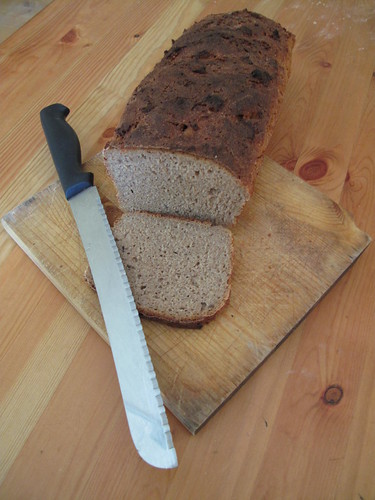
RYE BREAD (Magushapu Rukkileib)

This sweet-and-our rye bread recipe is from Estonian Tastes and Traditions by Karin Annus Kårner and takes several days to make! Plan ahead! First you ferment rye flour to make a starter and then feed it extra flour to create a base for your bread. In the end you have several loaves of hearty, flavorful rye bread plus starter to expedite the process for the next time. I am not going to write the whole recipe here because it is quite long, so if anyone would like it I can scan it and send it to you. The one thing I purposely did differently than the recipe was in baking: I used Ülle's trick of baking for the first half hour at 250 degrees C, the second at 200, then at 150 - this gets a nice crispy crust. Serve with butter!

emma's first rye bread is... WONDERFUL!

The delusional belief that one has turned into an animal, especially a werewolf. In Europe during the Middle Ages, lycanthropy was commonly believed to occur due to witchcraft or magic. One modern theory is that the rye bread of the poor was often contaminated with the fungus ergot, which caused hallucinations and delusions about werewolves.

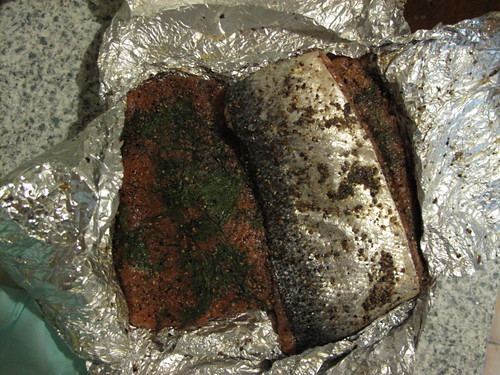
GRAVLAX WITH SOUR CREAM-DILL SAUCE

gravlax

Buy high quality wild salmon fillets. Rinse and dry. Cut the fillets so that for every piece there is another corresponding in size - effectively you are going to be making salmon sandwiches. For instance, if you buy one fillet, cut it into two pieces that are about equal in size. Rub the salmon with vodka or a combination of vodka and aqua vit. Make a mixture of coarse salt, freshly ground pepper, sugar and a flavoring spice like caraway or juniper berries. You will need quite a bit of this mixture, which you will rub over both sides of the salmon fillets. Cover completely, then sandwich the fillets together (skin side out) with copious amounts of fresh dill in between them. Wrap tightly in plastic, put on a plate, then weigh down with a brick or heavy weight in the fridge. Turn the salmon approximately every 12 hours, and let cure for three days. When you are ready to serve, unwrap and rub off the excess salt rub. Cut thin pieces with a sharp knife, moving with the grain of the fish. For the sauce, thin a cup of sour cream with a tiny bit of milk. Add a teaspoon of vinegar (white wine or sherry perhaps), salt and sugar to taste and lots of fresh dill.

grav- (scandinavian): hole in the ground; grave
-lax [aka 'laks']: salmon

Gravlox was originated by fishermen in the middle ages who would bury salmon in the sand of the ocean shore, where it would ferment favorably.


VODKA + PICKLE

"With proper vodka snack a person always remains the mister of position, can always completely control himself and receive only stimulating aesthetic effect from vodka drinking, instead of rough intoxication."

-BOWL

PORK BROTH WITH NETTLE DUMPLINGS AND STEWED CABBAGE

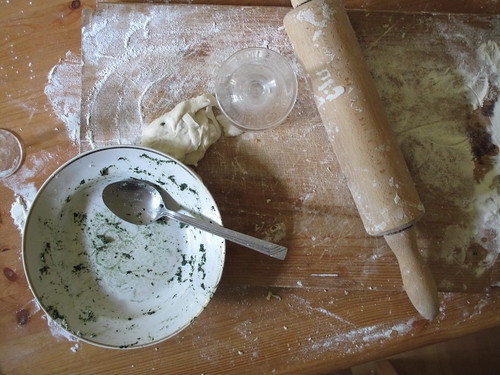
I made a rich a flavorful broth from the bones and remains and squirrelly bits of Mr. Piggy and assorted aromatics that found themselves in the pot. I stewed the pig skin for several hours in the broth as well (that was removed before serving and made into the above mentioned crostini) and cabbage. This cabbage was an impulse move, a last minute inspiration in the kitchen, and became the little star of Meal 2 for me, although among the flashier menu items was hardly noticed by anyone else. So flavorful and tender! The lacy cabbage tendrils nestled between the succulent dumplings and velvety broth was just heartwarming for me, a surprise success. The dumpling dough, in typical Estonian fashion, was made in a 3-1 ratio of flour to potato start, with cold water added by the tablespoon to form the dough and a little salt. Chill, then roll out to about 1/4 inch thick - you want it to be thick enough to be "toothsome" and to hold the filling in adequately when you cook - and cut into circles with the rim of a glass. This round was filled with a mixture of gathered nettles that were steamed and pureed, fresh ricotta cheese and salt and pepper to taste. Pinch closed and seal with cold water on your fingertips. Boil in the broth right before serving, or do them ahead of time in plain water and add to the broth when serving. They will rise to the top when ready.

nettle dumpling remains

stinging nettles: urtica urens

ta sai nõgeste käest kõrvetada (literally 'he was stung from the hand of nettles').
the powers of nature in ancient estonian culture and in the language are represented as a single hand. a pair of hands is one hand (as with all the symmetries of the body). to speak of a single hand (right, left) is to speak of half a hand. the hand of the nettle stings.

Milarepa, the great Tibetan ascetic saint survived for decades of meditation only eating nettles. his hair and skin turned green. he lived to age of 83. That's just wonderful. Nettles in the pocket protect one from lightening. Fortunately. Enhance fertility in men. What doesn't. Native americans used nettles to make fishing nets and ropes; while the Germans during WWI, due to textile shortages; their uniforms 85% nettle fiber


-FORK

HONEY-MUSTARD GLAZED PORK ROAST (Seapraad)

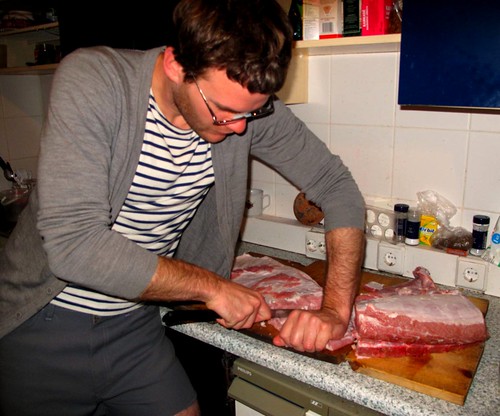
Matt beautifully butchered this roast from Mr. Piggy, which sort of looks like a cylindrical meat log that you cut from under the ribs (ish). You want to leave the layer of fat it has on top, as it insulates the meat when roasting. I salt and peppered the roast, then marinated it with a mixture of local honey, mustard and mustard seeds. Roast at 250 degrees C for 30 min, then reduce to 200 for another 30, then 180 until it's done. This was my first roast so I'm no expert source, and although they say 35 min. per pound + another 30 I had no idea the weight of our roast so I just winged it and Evelyn's mom poked at it to test the juice level. This one ended up a little overdone for my taste but not a bad first effort. Let rest before you serve.

skinning aint easy

SAUERKRAUT BRAISED IN BEER WITH CARAWAY SEEDS + APPLES

In Mooste there is a local farm with its own factory kitchen that makes sauerkraut and pickles for the village shops and restaurants in the region. We were lucky enough to visit this farm and kitchen, but more on that later. We used their sauerkraut for this meal, and braised it in beer with caraway seeds and apples to pair nicely with the roast. We used a local dark beer, covered the sauerkraut just barely in a saucepan and let simmer along with the caraway seeds for about an hour, adding the apples towards the end.

Mooste sauerkraut

Dr. Lejla Kazinic Kreho (croatian nutritionist) says: "I can only suggest all men try it. Eat cabbage twice daily and observe how your sexual power increases."

BROAD BEANS WITH BUTTER AND PARSLEY

Broad beans are very popular in Estonia, and the markets are flooded with fresh ones in their pods during summer that are boiled, salted and served whole. We were too early for this phenomenon, but purchased last season's, dried and quite cheap, from a market vendor. Soak overnight, drain, bring to a boil in fresh water and simmer until tender (like any dried bean) with aromatics. Turn off the heat and salt the water. Leave for twenty minutes then drain. Warm to serve in a pan with butter and top with fresh parsley.

POTATOES + DILL

New potatoes were parboiled, chopped and sauteed with butter, salt and dill. Simple and delicious!

Estonia has an institute, Jogeva Sordiaretuse Instituut, for warding off the late blight that set upon the Irish to create their potato famine in the late 1800s. the US had potato blight listed as one of their 17 agents for its suspended biological warfare program.

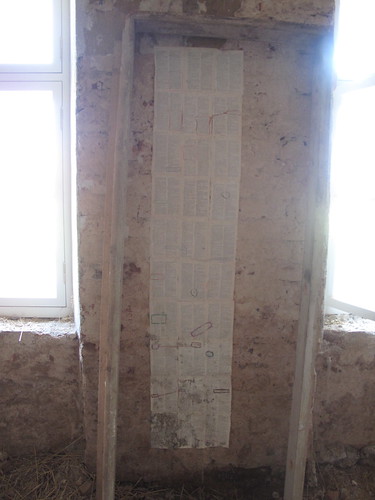
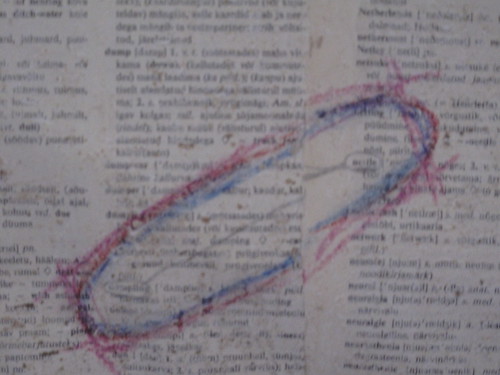
The written menu was constructed from pages from an English-Estonian dictionary as a document of single words, and pasted on the wall opposite the central table inside an old door frame.
Plate + Menu + Cup
Rye + Bread + Butter

HARRY EGIPT SCREENING + DESSERT

tough

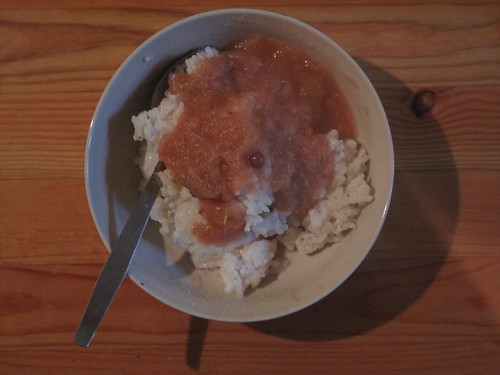
RICE PUDDING + RHUBARB COMPOTE

Prepare compote in advance by peeling and chopping rhubarb and simmer in water with sugar to your desired consistency and sweetness. As a topping I prefer a looser, less reduced compote. Chill and serve cold on top of the rice pudding, which I made by covering short-grain white rice with milk and simmering with a cardamom pod until cooked. I whisked together sugar and an egg and incorporated this into the mixture over low heat to thicken. Add brandy at the end to flavor.


emma and matt's rice pudding with rhubarb compote

MORE IMAGES...

Meal 2: John, Sveta, Tero, Karolina

Ülle

meal 2, room 2 coming together

Meal 2: Hanna lovin it

Parja eating Pork broth+stewed cabbage+nettle dumplings

MEAL ONE: ENVIRONMENT (A Journey)

Participants (9): John, Tero, Karolina, Helen, Hana, Ülle, Ati, Uku, Mari

With meal one we placed emphasis on the village of Mooste itself and its sites of production, history, and natural beauty. The food and drink offered at these sites reflected an aspect of their character or offered a kind of counterpoint to them. The six stations served as nodes for movement through the village, so that often the path to get between them was as important as the destination. We utilized the lake where locals fish, the village grocers, an abandoned barn, a tree-lined lane for retirees called "Pensioner's Alley", a deserted Soviet weigh station (evidence of a once-bustling agricultural economy), and a family garden. The journey culminated in a picnic in an apple orchard, where setting, food, and musical activities guided a beautiful sunny day together.

Participants met on the steps to MoKs at 1:00 pm on Thursday, June 18th. The weather was warm and sunny, and after several weeks of rain was a welcome relief (and a good omen). Everyone was given a wreath that was handmade by Emma from local greenery to wear on their head, an envelope with "$/EEK" written on it, and a map of close-in Mooste. The map, hand drawn by Matt, was constructed to be both (essentially) technically accurate, as a way to guide particiapants on their journey, but also as a representation of our experience of Mooste through our explorations on foot, and therefore pictured Mooste as seen through our perspective. Participants were told they had an hour and a half to journey together or alone and to visit the six stations marked on their map with a circle symbol. There would be a pole marker at every station. People were encouraged to visit any or all of the stations. At 2:30 everyone was instructed to meet at the station marked "Orchard."

meal 1 mappy


A: STATIONS (Duration: 2 hours)

1. ABANDONED BARN

In a small, dark barn often used as a hangout by teenagers, we set up a table from tree stumps and an old door found in the area. We poured a mound of dirt on top of the table, and crowned it with a tower of cake. Rhubarb, one of the first signs of spring, is a revered plant in Estonia, common in everyone's garden and transformed into a dazzling array of kissels, compotes and sweets.

meal 1: barn station

meal 1: barn station

emu's rhubarb cake! (For the barn soil install)

RHUBARB CAKE - RABARBERIKOOK

Cream together 1.5 sticks of butter (150 grams/16 Tablespoons) with 1 cup of sugar. When it is light and creamy, add 1 egg. Beat. Add 2 1/3 cups of flour, a pinch of baking powder and salt. Mix with your fingers to combine well. Grease a baking pan and preheat the oven to 350 F/175 C. Press the dough into the pan. Peel as much rhubarb as you can handle (and we can handle a lot) and chop it into small pieces. Lay the rhubarb on top of the dough. Beat six eggs, then add sugar (approx 6-10 Tablespoons), a pinch of flour (or more if you prefer a thicker topping) and some brandy to the mixture. Don’t overwhip the egg mixture. Pour over the rhubarb and dough. Bake for approx 30-40 minutes, or until the cake looks done to you and a toothpick comes out clean. You want the topping to be nice and soft yet the bottom crust to be firm. When it is to your liking, take the cake out and sprinkle powdered sugar over the top, then brush the surface with brandy. Put it back in the oven momentarily to melt into the cake. Repeat this last process if you, like us, are a glutton.

2. MOOSTE LAKE

Mooste Lake is a central geographical feature of the village, and we have enjoyed walking around it, swimming in it, and fishing from it. We set up a fishing station with Emma at the main lake dock with two poles, a worm bucket and a bucket for caught fish. Our trade off for the beautiful day was overexubarant wind - and sadly our two poles were whisked away before fishing began. Luckily, we had brought beer to share, as fishing became more of a spectator sport for us that day...

meal 1: fishing station

meal 1: fishing station

meal 1: fishing station

ESTONIAN BEER

There are so many kinds to choose from and they are all delicious! For the Fishing Station we chose a 2 Litre plastic bottle of Presidente pilsner – après pos for a nice day. Yellow plastic cups make it festive!

3. WEIGHT STATION

In an old Soviet weigh station Matt held a memory booth. Participants could listen to field recordings and special musics from our time in Mooste, make recordings of oral memories of Mooste or draw interpretive maps of Mooste. There was a scent museum filled with: parsley, onion skin, dried oregano, rosemary, orange peel, thyme, hyssop, garlic skin, mint, dill, black pepper, flower, coffee, caraway seeds, star anise, fennel seeds, rye flour, sugar, sea salt, and citric acid.

meal 1: memory station

meal 1: memory station

smell center with candy and map drawing

ESTONIAN CANDY
(Kalev!)

4. HOUSING GARDEN

Mari's mother, like many of the villagers living in the block housing units, has a garden plot within a larger series of plots. Each person tends to their own plot, growing enough vegetables for themselves that produce is hardly necessary to sell at the local grocery stores. Mari stood post at her mother's garden plot, showed visitors around and answered questions about the garden.

meal 1: mari's garden station

meal 1: mari's garden station

meal 1: mari's garden station

marbled eggs for the garden

MARBLED EGGS
Hard boil eggs. Let them cool a bit then crack the shells all over with the back of a spoon. Reboil the water with a bit of vinegar and a heaping of tumeric (or any other natural colorant). Add the eggs back in for a few minutes once the mixture is well combined.

5. LOCAL STORES

People were instructed in their envelope marked “$/EEK” to buy a specific item to bring with them to the orchard, and given a specified amount of money to do so. Their map showed two places to make this transaction possible, either of the two village stores. This option provided participants with a consumer choice in both location and the specifics of the item to buy.

meal 1: shopping station

meal 1: shopping station

SHOPPING LIST
Possible items were: Black bread (3 people), butter, "rollmops" aka marinated herring fillets, juice (2 people) and cheese.

6. PENSIONER'S LANE

A trail of candy was left on the ground, leading all from the garden to pensioner's lane, a tree lined path for retirees. Nettle tea was left on a man-made stoop along the path.


meal 1: pensionaire's station

meal 1: pensionaire's station

meal 1: pensionaire's station

meal 1: pensionaire's station

NETTLE TEA
Pick nettles (with gloves) as far away from the road or buildings as possible. Wash them well, and remove the leaves from the stems. Boil the nettles in hot water. Serve the liquid hot, or let it chill. Apparently, if you add lemon slices it turns pink! It’s even better if found at the end of an Estonian candy trail…


B. ORCHARD PICNIC

meal 1

Setup: Suspended white fabrics, handmade pinnents, doilies, chemistry vessels, window frames, rope, tarp and blankets on ground.

Orchard 2

Meal One: Menu

meal 1 in the apple orchard

Music: Using suspended chemistry vessels, glass bottles tuned with water, and reeds from a reed organ, all were lead in an exploration of the temperament Matt chose for these instruments. A circle game then followed, all continuing until someone "messed up" or laughed and we would start again.

Uku

Tero fairy

Mari, Ülle, Ati, Uku

Hanna goes for a stroll

PICNIC FOOD RECIPES:

OPEN FACED SANDWICHES
Open-faced sandwiches are a popular food item in Estonia. We constructed them at the picnic from the supplies people bought at the shops (black bread, cheese, butter, marinated herring fillets, moose sausage we bought in Tartu and...

EGG SALAD
Hard boil eggs. Slice into small wedges and put into a bowl. Grate a generous amount of cold butter over the eggs, a dollop of mayonaisse, and small bit of mustard into the bowl. Mix well. Season with salt, freshly ground black pepper and chopped dill. Butter black bread and put on top.

LOCAL JUICES, NETTLE TEA, BEER

SPRAT AND POTATO GRATIN

(inspired by Anni Arro)
Buy fresh herring at the market (this is probably impossible in the US, so buy tinned ones and go on to the next part). Clean and gut the fish, dry well, and roll in flour. Fry in hot-hot canola oil. Eat with mashed potatoes and wine, if you are lucky.
Use the left over fried herring for the gratin. Thinly slice potatoes and par-boil them. Sautee some onions until they are a bit crispy. Butter a baking dish and put down a layer of potatoes. Stagger layers of the herring, onions and more potatoes until you run out, and a healthy sprinkling of salt. Feel free to add herbs, capers or the like. Top with your last layer of potatoes, and dab butter on them. Mix an egg or two with whipping cream and mix. Pour over the dish. Bake at 350 F/175 C for about an hour.

BEET SALAD
Boil, peel and chill beets. Chop into small wedges. Toss with fresh ricotta (kohupiim), peppermint and parsley. Drizzle lemon juice and olive oil, salt and freshly ground black pepper.

APPLES AND HONEY
Buy the best of both locally and combine happily.

CATCHING OUR BREATH

Hey all, well as of Saturday July 27th we completed our 3rd and final meal for the MoKs residency. It went wonderfully and we'll be posting more and much info and images on each of the meals very soon.

Meanwhile... we've been completely occupied by the project and day to day living (cooking, keeping the fire going, killing flies); and we've taken these final days "off" to enjoy Mooste, before leaving for other travels in the next day or so. We've been... swinging on an old group swing,

group swing

picking wild stawberries in the nearby forests,

wild strawberry pickin day

swimming in Mooste Lake,

Mooste lake: sunshine and kids
IMG_2314
IMG_2307

and, of course, cooking, eating, and drinking away our free time together.

caraway cheese, sandy's rhubarb compote, matt's bread, honey comb, bees knees

We're already feeling a little post-partem depression creeping in. One month was clearly not enough and we're just finding time to exhale and really absorb the place and our experience. But our hearts have definitely found a home here.

Ok, more coming soon. Stay tuned! Love...

MM

Jun 24, 2009

Lady's Mantle: Alchemilla Vulgaris

I've decided when I get a garden I'm going to have a "woman's" plot filled with plants like these. Thanks to Evelyn for this wisdom and for hunting with me.

alchemilla vulgaris (lady's mantle)


Named after the Virgin Mary's cloak because of its scalloped leaves. The name alchemilla ("little magical one") derives from the dew which collects on it - dew being formerly associated with magic. The dew was used as a beauty lotion by country people. Nicholas Culpeper claimed that the juice of this plant could firm up sagging breasts, while pillows stuffed with it could bring on a good sleep.
As an astringent Lady's Mantle paradoxically both promotes delayed menstrual flow (an emmenagogue) and reduces abnormally heavy or prolonged menstruation (menorrhagia) or bleeding from the uterus that is not due to menstruation (metrorrhagia). It also has a role to play in easing the changes of menopause. The same astringency can play a role in the treatment of diarrhea and as a mouthwash for sores and ulcers and as a gargle for laryngitis.

I washed the plants and made tea from them (with water that had rested after it boiled) to help with my kick-your-guts-on-the-curb cramps. Also helful: Sage.

JAANIPAAV, Part One

We thought we'd stick it to the Estonians and celebrate our Mexican-American roots. Or just missing Juan, maybe.
IMG_1887
IMG_1893
IMG_1896
IMG_1889
table table
cheese, beans, cabbage
IMG_1942

Cast: Matt. Emma. Sveta, MoKs board member from Russia who has been staying with us while she silkscreens her heart out. Sandy, our new co-resident from New York via Wisconsin who makes drawings and sculpture, has already swam across Mooste Lake and can clean the hell out of a kitchen. Mosquitos, usual.

Setting: Field next to MoKs Bear-Graffiti Barn. Matt made a table out of some tree stumps and an old door he found. Hooked up battery powered speakers to computer playlist. In honor of performance art and nerdism, we have been playing "Ouilipod," where a random word is put into the search bracket of ITunes and we listen to the results. For this go around, Matt put in "woman," "grass," and "sunshine," I beleive, and made a shuffle of the total results.

Menu: Braised pork (the last of Piggy!), black beans (grown by a woman we met in Tartu), cabbage salad, quick pickles (cucumber, onion, garlic, carrot, radish), Estonian cheese (Voru Juust), rice, Dippi-infused sour cream (Sveta's party specialty: essentially a garlic powder and dehydrated vegetables mixture that you pour into sour cream. I love it...), fried fish that we had caught in the lake earlier in the day, homemade tortillas with hand-rendered lard, and good old Estonian beer.
Sandy's Fire
Marshmallows Gone Wrong

We finished the night with a lovely "tee pee" campfire that Sandy expertly arranged, a present from Amsterdam and some fucked up marshmallows. Two nights before Karolina and I made some wonderful homemade marshmallows that we flavored with sea buckthorn juice and sadly were consumed without any documentaion. This batch did not turn out properly, as the gelatine separated and created a double-layer jelly sweet - quite delicious but incorrect. We flavored half this batch with strawberry and half with brandy and lemon. Recipe to follow upon further success story.

PIGGY

There is a pig farm less than half a mile from where we lay our heads at night, which we had no idea about (although we had seen the building) for weeks. The pigs are silent. Also, apparently, odorless. We still have not been inside, although we have put in an inquiry of interest to do so, because this past week was slaughtertime for the Pig Man in preparation for the Jaanipaav, St. John's Day, which is the big summertime fun holiday in Estonia (and Scandinavia as well). The translation for Jaanipaav is the "midsummer," essentially the summer solstice, and has certain pagan rituals involved like bonfires and the consumption of pig. So we were told that the Pig Man was very distressed last week to have to kill all his piggies, as apparently the cruel realities of the trade haven't fully hardened him yet, making a visit to see him impossible for the time being.

But he delivered us by hand some pig, anyway:
we got pig from the pig man today

This rib-loin-ish piece was presented in a black garbage bag. Skin intact, bristles thankfully removed. ((There was a loin-belly-ish piece as well but Evelyn's mother got that prize.)) Neither Matt nor I have ANY experience in butchering, and the IKEA knives were tested to their limits on this. Luckily, I ask too many questions at work and watch the wild woolly men at their posts, so I knew a thing or two-ish after all, but Matt is stronger than me, and time was of the essence...
skinning aint easy
skint
breakin it up
In the end, we produced a loin roast (consumed in Meal Two - post coming soon) five ribs (that were chile rubbed and barbequed over the fire on Tero + Karolina's last nite), the skin (half was attempted into fried pig skins, the other half I made delicious stock from and then sauteed the now soft pieces into crostini at Meal Two), fat (rendered into lard, which we made tortillas from last night!), some assorted pieces that we just ate or shish-kebabed, and some bones, etc that I made into a pork broth for Meal Two.

Jun 17, 2009

VARIATIONS ON GOLDBERG: Soviet Sleepies

Glenn Gould's copy of Bach's "Goldberg Variations"

The Goldberg Variations, an extended collection of harpsichord pieces, were written by Johann Sebastian Bach, first published in 1741. These pieces came to be written via Count Hermann Karl von Keyserling (1696-1764), the Russian ambassador to Saxony, who was suffering from Insomnia. Count Keyserling's companion, Johann Gottlieb Goldberg, was a harpsichordist working with Bach. The Goldberg variations were written for him to play "to the amateurs for the enjoyment of the mind". But they served even moreso to lull the Russian Ambassador during nights troubled by insomnia.

Count Hermann Alexander Keyserling (1880-1946)

One of Keyserling's heirs was Hermann Alexander Keyserling (1880-1946), a heridetary Count from Raykull, Estonia. Keyserling lost his Estonian estate during the Bolshevik revolution. He married the granddaughter of the German leader, Chancellor Bismark. A philosopher and author, he was one of the earlier Western thinkers to promote a global culture, founding the "School of Wisdom" in Darmstadt, Germany in 1920, which is still in action under his son and their followers. His brain has been preserved and displayed in a museum in Bern, Switzerland (alongside Einstein's); though eventually his family had his brain returned to his body.

Putting the Soviet to sleep. One has this lulled sensibility here. The village is fairly sleepy, certainly active and productive, but relaxed and unhurried (stores dont typically open until around 10am). Meanwhile the abandoned Soviet buildings sleep like giants strewn across the village. I hear the goldberg variations everywhere - that and the music of Ian and Sylvia Tyson, which emma and I sing incessantly. And both of these musics are being featured in some of the sound pieces I'm putting together for a "memory station" within the old Soviet weigh station not too far from MoKs.

ONCE BITTEN, TWICE THE WRATH

70 mosquitoes

70 and counting, and that's just on the front of her legs... She takes them down like Godzilla

ANOTHER KIND OF BARK

the muntjac deer

Maybe others know this well. But when we first heard and saw a deer barking in the apple orchard the other day, well for me it kind of blew my mind. He'd leapt right out not but a few yards from Emma. The Muntjac is commonly found in Estonia. Looking forward to commonly finding them.

Jun 16, 2009

Bearings

Learning our way around. I made this map in part to better understand the kinds of production that go on here (unmarked as yet) and also for our first meal, involving stations around Mooste, this thursday. The MoKS residency is in a walled-in estate, an old farming complex. Within this gate there is also a small store, a hostel, a flax museum, and a few farming facilities. Here is my Mooste...

Mooste map draft 2

Speaking of maps... During our recent visit to Tartu for market goodies we stopped into a nice little book store. I found some bizarre postcards and Emma found some beautiful maps. This 1968 map of Tallinn:
Map of Tallinn (1968)

This Estonian language map of Europe (date?):
Estonian-language map of Europe

And this Russian language map of Estonia (date?):
IMG_1458

...a postcard...
postcard

Jun 15, 2009

The Hard Part

We are at the critical juncture-ish point in our residency. This week we have two of our meals, the "conceptual" ones. It feels like we need another week to do what we want, as it's been harder to make things happen than I anticipated with our lack of know-how here, but it will be nice when they're done to feel like we produced something, to have something tucked under our belt. Evelyn scored for us today with some hook-ups with local farmers and hunters which hopefully will come through, but we have to go to Tartu again tomorrow for supplies anyway. There are squashed mosquitoes all over our studio because we've been killing so many there's no point in bothering getting up to dispose of them, and our fireplace backed smoke all through the room tonight, but we did have a sweet session with a scythe in preperation...
reapin
I'm excited, but nervous, etc etc.
Here's our awesome breakfast from yesterday:

PANNKOOGID
today's brunch

Mari's recipe -
Take 1/2 L. of milk, crack 2-3 eggs into it, beat, and add just enough flour to keep it runny. Leave on the counter, covered, for at least an hour. Fry up with butter nice and thin.

Our fellow residents Tero and Karolina joined us for a dessert pancake. Karolina had the genius idea to go buy ice creams for the occasion, which we put inside with the rhubarb compote and other treats.
icecream
Aurora, the ship that "started" the Russian Revolution

It reminded me that when I was in Japan (ages ago now) we ate crepes with ice cream in them... Karolina told us today that she had a dream about food inspired by our Anni Arro cookbook, which has the most beautiful photography. She dreamt she was making a meal and kept trying to put it into a glass jar, as if to can it. Indeed!

Jun 14, 2009

ABANDONED, WITH LOVE

staircase to (for orland)

Besides the beautifully pastoral landscape, MoKs has the unique ability to offer its resident artists the many abandoned spaces around the village. Co-director of MoKs, John Grznich's practice and project, revenant, grew out of his using the microphone to "play" the sounds of many of these spaces. In any case many of these buildings are unused and dying a slow death; others have been redefined or renovated; while still others have become sites of usufruction, where ownership and use of nearby materials (tractors, granary machines, thingamajigs) is as mutable as water. Meanwhile... visiting artists often approach these sites with an intent to vandalize, decorate, or transform into an ephemeral performance venue.

For a good portion of its' life Mooste was a collective farm under Soviet order. These farming buildings were gradually abandoned following the removal of Soviet occupation in the early 1990's. Not long after, the railroads were privatized and gradually abandoned - there are no more trains in Estonia, though busses are available for most locations. Collective farming died. People now use local stores with cheap goods and, more recently, tend private green houses. The community has slowly been redefining themselves ever since. The many granaries used heavily during occupation are still here; some are still used though not to optimal capacity. Things are being renovated slowly. And while Mooste itself may be culturally enriched or infected by the addition of new businesses and dwellings via these renovations (inevitable), there is something beautiful that will have been lost when these fragile and multipurpose mnemonics have been replaced or disappeared.

old weight station, future memory station
abandoned weigh station (interior, side)

to become a temporarily functioning bar
abandoned neighborhood bar (+nearby 'singing square')

old granary? (community space?) - well, beautiful!
granary turned community performance space (interior, front)

she never hollers coo coo (Graffiti room)
farmhouse turned "graffiti barn" (interior, left side), neighboring MoKs

in the oil tanker
abandoned oil tanker (interior) a 6 second reverberation time makes this stinky cylinder quite a place to sing (recordings coming)

discontinued granary
this abandoned (?) granary sits at the center of town, across from the Mooste elementary school

submerging house
some buildings are literally sinking

dream silo (more soon!)
abandoned grain silo - a personal favorite

door of doors
Many are closed (locked or encased by brick), empty or used to store other unused 'junk'

PUPPYISM

I'm not sure if it's their heritage of animal worship or what... but leafing through the English-Estonian Dictionary (1990) the other day with Tero, the term "puppy" was being used in ways strange to us all:

IMG_1320

Jun 12, 2009

Tartu Farmer's Market, thank goodness

rhubarb!

mmm
pickles (everywhere)

Strawberries everywhere. The Estonian ones were few and expensive, as it has been too cold most places still - none have ripened for my eyes in Mooste yet, for instance - so the affordable and abundant berries had been trucked in from Lithuania. Onion scapes, new pickles (not long in the marinating tub), still plenty of rhubarb. We bought fresh herbs (peppermint, parsley, dill), dried broad beans, radishes, plain raw milk yogurt, arugula, cauliflower, fresh garlic. A whole corridor of the market is potatoes, 90% of which vendors were still hocking last year's crop at only 5 kroons per kg (aka dirt cheap), but we splurged for new red potatoes which we ate roasted in their jackets with butter and dill.

CATS, ALCOHOL, MATRIARCHY?

sketchy kats everywhere

I've noticed a feline theme running through this town. Statues in the fields...

catue

and drawings in the buildings...

Cat Pics (Mooste School)

A MoKs friend has said that one of the head teachers in the village school is obsessed with cats. All the students draw cats. He said this was one among several examples of a curious matriarchy underlying the village (MoKs was founded and is run by a woman, Evelyn Müürsepp - though the mayor is a man). The men, he says, unable to fit into society, drink and drink and drink (we've seen plenty examples of this).

closer view
A statue in the Mooste School

I'm not sure of this theory, but it wouldn't surprise me. Though amongst the chickens we were living with, the roosters killed all three hens. Micro-cultures are wonderful...

Home Sweet Home

Speaking of food... The world is strange and interesting.

Jun 11, 2009

a few

chicks gettin bigger
she never hollers coo coo (Graffiti room)
the blue, the black, and the white
bread workshop
a beautiful economy

THREE MEALS (A PROJECT)

MEAL ONE: ENVIRONMENT (A JOURNEY)

Thursday, June 18th, 1:00 pm

Guided by a map, participants will nomadically explore the village of Mooste around the MoKS property. We will travel to different stations and natural sites that highlight the origin of food, its sensory components, how it is produced, represented and, at journey’s end, consumed in a naturally staged environment.


MEAL TWO: BOUNDARIES (AN EXPERIMENT)

Saturday, June 20th, 6:00 pm

We will explore our collective relationship to the intimate experience of eating as expressed through isolated aspects of Estonian food culture. We will dissect, examine and enjoy the elements of a meal in two locations that will be redefined for the evening.


MEAL THREE: COMMUNITY (A TRADITION)

Saturday, June 27th, 6:00 pm

You are invited to attend a sit-down dinner constructed from local ingredients. This meal will be accompanied by live music in a beautiful setting. Please wear white (if possible).


Please RSVP so we know how many people to prepare food for. For all meals, please be prepared for the chance of rain.

gettin' over the brainstorming hump

notes - project forming well and good

Jun 10, 2009

EESTI

"The majority of Estonian food is very simple, and for a long time, grain and bread were in first place, with potatoes being added later. Milk, salted fish, and pork have also been part of the daily menu.
Traditional Estonian dishes are conspicuous for the simplicity of their preparation. The same food could vary somewhat from place to place. The food was given a unique pleasant taste by the threshing barn oven, and any seasoning cannot duplicate its effect. The way of placing the food on the table was extremely simple: soup in a wooden bowl, a large piece of meat on a platter, accompanied by rye bread. At other times, however, butter in a wooden tub, hot barley bread with cold fresh milk, and stewed mulgi sauerkraut with pork.
The staple food for Estonians used to be bread and various other flour products. Whereas, bread was considered to be sacred, and one was not supposed to throw it or step on it. Other food, primarily animal foodstuffs, such as meat (salted), fish (dried, salted, fresh), and butter were called bread side dishes. Milk and dishes prepared from it was used infrequently. During the milking season, butter was produced and salted to preserve it for fall and winter. Pea, bean, lentil, barley, and flour soups played an important role at the dining table. Porridges were also popular.
Food for festive occasions included barley sausages (bloodless white sausages in North-Estonia, and blood sausage in South-Estonia), pig’s head, pork, and headcheese. Small pies with various fillings were also prepared.
Starting at the end of the 19th century, new foods, which previously has only prepared in the towns and manors, started to proliferate. The amount of store-bought food and seasoning increased. Different types of baked white breads and cakes; barley porridge was often replaced by farina or rice pudding. Herring and potatoes appeared on the table.
The grain foods were most important for Estonians, and barley and rye were used most often. Today, Estonians still love rye bread, which has been an everyday food since the 12th century. Dishes from oats and hempseed were prepared to a lesser extent, and wheat products did not reach the Estonian food table until the end of the 19th century."

From here .

Jun 9, 2009

May Your Bread...Rise

So I have been playing around with simple soda bread. We were out of bread the other night, the shop was closed, and we had ingredients to make it. Flour, kefir, salt, baking soda. Note: Baking soda in Estonia is inactive, one must squeeze a bit of lemon on it to make it bubble! I am trying to keep all my cooking projects within the Estonian echelon, so even though soda bread is connected to the Irish tradition, Estonians indeed make simple bread with their beloved kefir. I have no experience making bread, and my two attempts so far have been edible but by no means great. Too doughy. Any suggestions? Please help!

We are going to Tartu on Friday to go to the Farmer's Market and to fetch 6 lbs of rye flour to attempt Estonian rye bread. Here is my inspiration, the lovely Ilme's delicious bread from the Estonian dinner at Navarre.


I have updated the past post about the dinner as well.

The Basics

A pinch of this, a little of that…. Estonians don’t seem to use recipes. The men stay far from the kitchen. The women from the country, like Leene and Evelyn, seem to know every plant and animal, how to cook everything, and have a solution for anything – they don’t need recipes. Estonians have far less kitchen gadgets than we do, and while they don’t use vegetable peelers they do peel rhubarb.
We have said this before, but Mooste used to be a farming estate. The land around here is vast and fertile, filled with farmland and beautiful stone and brick farmhouses. Before the Soviet years, the houses were far apart from one another, the Soviets forced people to move into block houses and actually transplanted farm houses closer to each other for control and to institute collective farming. After the end of collectivism, capitalism and cheap produce from Spain seemed liberating to people tired of backbreaking farm work with little reward – so despite the history of this region, people abandoned their farms. Only in the last year or two, since the economic “depression” began (yes, that’s what they call it here), have people begun to get back into gardening.
It is quite bizarre – the people around don’t even seem to know what their neighbors grow or how to acquire local produce – which does exist. The people were perhaps so spooked by abusive centralization that they now have none at all. We are working on discovering these secrets – but it is strange and frustrating, and complicated by our language barrier.
The two village grocery stores have slim pickings, and almost no produce. During Kliima Mike said we were eating “Crisis Food” because the budget have been reduced to 1/10 its original format. The food is cheap, though, and some things, like juices from nearby Tartu, are exceptional. We have been eating non-stop carbohydrates and dairy and NO meat since we arrived except some questionable pressed sausage (don’t bother). I am craving a steak.

CRISIS STAPLES
Rice, buckwheat, pasta, lentils.
Bread (leib) with butter at every meal. Never toasted.
Sprats. Small Baltic herring packed in a tin. Delicious on buttered bread.
Slices of cucumber, tomato, aforementioned pressed sausage.
Coffee. Tea. Vodka. Cheap wine from Hungary.
Milk, Kefir. Cheese.
Estonian, Russian and Ukranian candies.

A meal I made from Kliima leftovers to mark the arrival of our new resident Tero from Finland. Cabbage rolls.

Cabbage Rolls
First night with Tero (our co=resident at Moks)